

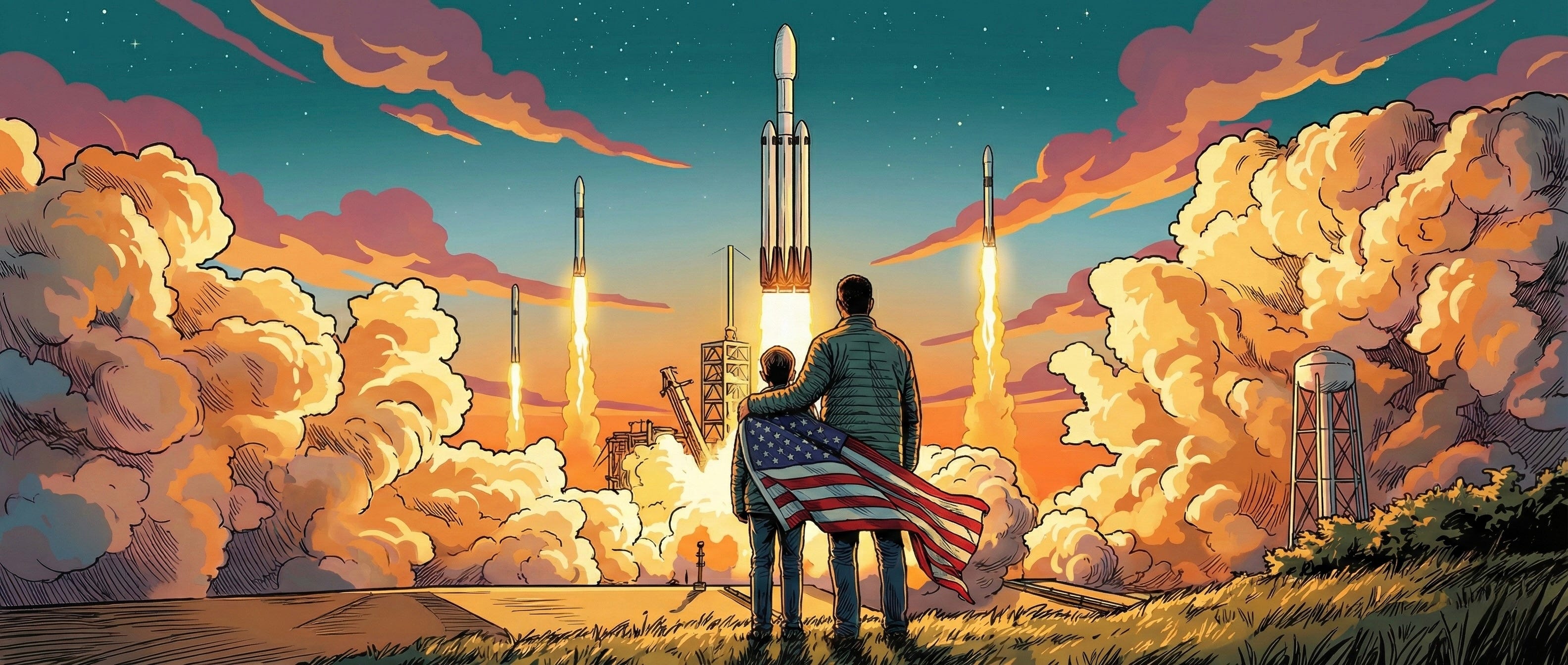
Coming into 2026, it was clear we were going to have an epic year for tech innovation across the board, but with so much activity across space launch, infrastructure, robotics & AI, it was a fair debate which particular field would make the biggest leaps.
In early Jan a certain mega-IPO was all anyone could talk about, and whispers of on-orbit Data Centers were creeping their way into the mainstream. Then on Feb 2nd the conversation exploded, as SpaceX acquired xAI in a $1.25 trillion deal, becoming the largest merger in history and the first vertically integrated stack capable of expanding intelligence to the stars.
Still, despite all the hype, I don’t think most people realize just how far this stack can take us, and what life will feel like when space truly opens up as an industrial layer and eventually a platform for tourism en masse. This might seem like a distant future, but space contracts in your direction when you start moving fast enough, and SpaceX + xAI is a true warp drive for the industry.
For the skeptics amongst you, who back in 2010 thought electric cars would never be a thing, strap the fuck in. Same central figure in both revolutions. 10 years from now we’ll be having similar discussions around human-machine interfaces… cough, Neuralink... But let’s stay on track…
As we know, launch costs have and are continuing to collapse. Before SpaceX, getting a kilogram to orbit cost at least $ 10-20,000, and often much more. Falcon 9 brought that down to around $2,700/kg. And Starship is targeting $10-100/kg at scale with full reusability.
Space used to be exclusively government programs led by the US, Russia, and China. Then ultra-billionaires. Now it’s corporations, smaller nations, and celebrities buying launches for suborbital trips. Soon it’s your everyday millionaires. One day it’s our kids.
Whatever your thoughts on him, Elon Musk has objectively operated as a Promethean-like figure in this transition. Now he is planning to build 10,000 Starships per year, which sounds fucking mental but 100% Elon-like, and I’m betting he’ll do it.
To put that in perspective, that’s more than 20 times the production rate of the Boeing 737, the backbone of the airline industry, and would mean 27 new vehicles rolling off assembly lines every single day. Air travel was originally for the very select few, now it’s for the masses. The same is true for most transformative technologies, and volume is how we democratize space access.
More volume equals more launches, and more launches equal more volume. Elon is saying here that he envisages enough demand for one launch every 52 minutes, and the xAI merger adds real demand to the equation, launching a million tons per year at 100 kW of compute power per ton would add 100 gigawatts of AI capacity annually. Which makes one rocket every 52 minutes look conservative.
To support that requires infrastructure comparable to global shipping: 20 to 50 offshore launch platforms, gigawatt-scale fuel production, and automotive-style assembly lines cranking out thousands of engines per year.
The space economy sits at $600 billion annually today, is projected to hit $1.8 trillion by 2035, and China thinks it could reach $10 trillion by 2050.
Space exploration has been defined by great goals, and the journey to those goals has gifted humanity with countless advancements in technology that have permeated every aspect of human life. Humans on Mars is still an ultimate ambition, but along the way, we’ll completely transform life as we know it.
Return to the Moon
In December, we swore in Jared Isaacman as NASA chief. Jared’s accomplishments include flying a jet around the earth in world record time, commanding the world’s first astronaut-less orbital mission whilst placing the first sports bet from space. In addition to leading the furthest flight from earth since the 70’s. Pretty sick resume. His team is explicitly clear on their mission whilst he’s in office - get us back to the moon and establish permanent operations on the lunar surface.
Along with the xAI merger, SpaceX has also realigned its priorities to a Moon-first, Mars-later approach. And the Moon will become the proving ground for the infrastructure we need for further colonization of the solar system.
“The mission of SpaceX remains the same: extend consciousness and life as we know it to the stars. SpaceX will also strive to build a Mars city and begin doing so in about 5 to 7 years, but the overriding priority is securing the future of civilization, and the Moon is faster.” - Elon, Feb 2026
In the next few months alone, we’ll be taking some big leaps towards reestablishing human presence on and around the lunar surface…
Artemis 2 is aiming for a launch before the end of April, sending four astronauts around the Moon for the first time since 1972. And we’ll shortly after have three separate missions heading to the lunar surface: Blue Origin’s Blue Moon Mark 1 delivering NASA experiments to the south polar region, China’s Chang’e 7 rover, and additional landers from Intuitive Machines and Astrobotic carrying everything from mini-rovers to instruments hunting for helium-3.
China have committed to a crewed moon landing by 2030, so the race is well and truly on. For all the pessimism in today’s world, I’m personally stoked to be entering into a second Space Race between the two great engineering powers, and the stakes even higher this time around with both sides playing for keeps.
Early this year we also have Vast’s Haven-1 launch. The ISS is one of mankind’s greatest achievements. Haven-1 will be the first commercial space station in LEO and is planned to host up to four missions over its three-year lifespan, with crews of four people spending 10 days aboard. This is a MASSIVE inflection point for human spaceflight. The very beginning of private orbital infrastructure that doesn’t depend on government programs.
Orbital AI
In November 2025, Starcloud sent an Nvidia GPU into orbit. In doing so, they became the first company to train an AI model in space. Whether or not you think orbital data centers become the hyperscale future Elon’s hyping, the proof of concept exists, Starcloud-1 is operating, it works.
The US burns through about half a terawatt of electricity on average. AI infrastructure is projected to need 100 gigawatts globally by 2030 – and that is most likely too conservative. The energy market in the US is already the most disrupted it’s ever been, and there is a mad rush to try and plug the gap. Terrestrial power doesn’t have a shot this decade.
Gas power plants are still the backbone of on-demand electricity generation, essential when you’re running compute 24/7. There are a ton of interesting developers in this space, but the production pipeline for these technologies is painfully slow because every component is a highly specialized manufacturing process. You’ve got blades that operate under insane thermal and mechanical stress, and they need to be cast from crazy alloys that can handle the heat without warping or cracking. There are maybe three companies in the world that do this casting at the required spec, and their lead times are already extending.
On-orbit the tradeoffs are completely different. Solar efficiency jumps 5x, there’s no weather/seasonality to account for, 24/7 pure starlight. The already cheap solar cell production cycle becomes even cheaper because the cells you send up need less glass and supporting material as they don’t have to withstand tornadoes, hurricanes, wildfires, and overall craziness of US weather systems.
No cooling towers are needed, as you radiate heat directly into the endless void. Removing another massive power sap.
The constraints completely flip from power to mass into orbit, which is where Starship becomes the difference maker.
At $10-100 per kilogram putting compute in orbit becomes cheaper per token than building another data center in Wyoming. Within three years, the annual launch capacity for AI infrastructure can greatly exceed on-earth construction.
Bandwidth may become an initial constraint, but not a fatal challenge. Getting data to and from space fast enough is tough physics. You could easily choke the entire orbital pipe if you’re trying to run things like a terrestrial hyperscaler. But nobody’s building this for the ChatGPT class. Radio frequencies are orders of magnitude slower than fiber optics. Optical lasers will be the way to go, getting them reliably through an atmosphere is tough, but there are many awesome brains already working on this problem.
GPU failure is, on face value, a fair challenge. They currently fail a lot, but reliability is increasing. More importantly, the space industrial layer will be built with robots at the helm. You could park a couple of dozen robots on the structure, doing continuous rounds. A card fails, the robot pulls it, slots in a spare from on-board inventory, dumps the dead unit into a return canister. You design these systems for an elevated failure rate given radiation damage, and everything still comes out ahead on cost-per-unit because energy is free and cooling is passive.
Robotics is another field where the rate of advancement is drastically underestimated by the average American. Once a permanent moon base is established, the economics of space-compute will be transformed again as we start to use silicon and aluminum-rich lunar soil for production, robotic manufacturing, and mass-drivers to launch solar arrays and chip clusters into position. Automation at scale is the second biggest enabler, alongside launch volume, that will make this vision almost inevitable.
All Roads Lead to Mars
So to recap, humans will be on the moon (again). America before China. We’ll be there by the end of 2028, maybe 2027 with the right headwinds, via Artemis 3. And we’ll have fully operational outposts on the surface by 2030 at the latest.
Prior to that, a scrappy start-up out of The Bay, GRU Space, is targeting a 2029 mission to test an inflatable, geopolymer construction for a lunar hotel! If you’re skeptical read their whitepaper, the inflatable habitat premise is well established and the execution pathway is sound, this will be the near-term go to for in-space structures.
By 2030, multiple private platforms will have permanent or multiple semi-permanent stations in orbit, and there will undoubtedly be significant commercial activity across manufacturing, research, and logistics, with tourism starting to ramp.
This will all be massively accelerated by SpaceX’s commitment to a Moon-first agenda. In January 2025, Elon called the Moon a “distraction”. Some people look at his twists and turns as faltering, but the master game player as always, he is strategic as fuck. The dead-set vision of Mars colonization has sparked countless minds, driving huge investment and talent into the sector to solve the hard problems today. The Moon pivot isn’t sudden.
Mars launch windows come every 26 months with six-month transit times. Whereas you can launch to the Moon every 10 days. He didn’t suddenly run the maths on this in the last few weeks. And every problem we solve on the Moon is a problem we don’t have to solve from scratch on Mars.
Landing large payloads with high success probability is a late 2030 in early 2040s problem, but once we get there, the learning curve from the Moon will accelerate how fast we scale on new orbits.
Crewed missions are realistically a late 2040s into 2050s bet. But the infrastructure build-out starts to happen by the end of the next decade.
In the next 5 years, we’ll live through the quickest accelerating and most impactful technological revolution in history, the singularity. Before we get to Mars, our goals will undoubtedly expand to even loftier ambitions. However, as the space industry on the moon scales, demand for Mars will also surge. Once the Moon’s territory is carved up, national and commercial ambitions will only increase. We will step foot on Mars.
The Elon Effect
SpaceX has spawned 141 companies founded by former employees in the last decade. Twelve have hit unicorn status. They’ve raised $10.6 billion collectively and created over 7,000 jobs. Thomas Mueller, SpaceX’s first employee and the engineer who designed the Merlin engine, is a prime example. He left in 2020 to found Impulse Space, to offer a solution when satellites find themselves stranded in the wrong orbit, plus much more. Impulse is now valued at over $1.8 billion.
Technology is people and process, as much as it is product. You might hate Elon, you might think the SpaceX IPO is a money grab, that on-orbit data centers and mass drivers on the moon are ridiculous ideas, but regardless of whether these ambitions succeed or fail, NOTHING ENDS UP IN THE TRASH.
If you invested in a crypto startup that raised a $80M series A, and the next month their founder is arrested in the Bahamas, you definitely spunked your cash. But at the frontiers of the big problems, every investment moves us forward. Even if timelines slip or the idea just doesn’t work, the pursuit creates new knowledge and new capabilities that make the next venture possible.
A sky is most definitely not a limit for man and it never has been.